The Arts of Transmission
Critical Inquiry
Volume 31 no. 1
Monday, February 09, 2009
Lawrence Weiner on working with words
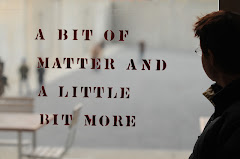
A New Yorker born and raised, Lawrence Weiner’s mission in life is to get straight to the point. It’s a quality you cannot miss in his artwork, in which big ideas are communicated using the minimum of words. In this film, Weiner tells us why he’s against Helvetica, and how he came to design his own font. He also shows us around his studio and allows us a sneak preview of projects that are still on the drawing board.His work is included in the exhibition Colour Chart, which comes to Tate Liverpool in May 2009.
Watch the short film (3 mins.) here on Tateshots Issue 19 NYC Special
Lawrence Weiner: I am one of those lucky artists who has been able to remain in exactly the same position as a human being as when I first jumped onto the ice floe. And luckily people have dropped sandwiches and cigarettes on the iceberg along the way, so I can sort of sit there. Where I’d like to be tomorrow is where I am now, doing public installations about things that interest me. I’m doing one in Denmark which takes over this whole city. I’m building the whole piece out of cobblestones. It breaks right into the highway, and on the highway people are offered a choice between paper and stone, and water and fire. Every single child knows what it means. I don’t know if adults know any longer. Fire and water means joining the circus; paper and stone is to make yourself a stable set up in that society. The piece runs through the vestibule of a building into this enormous courtyard, and in this courtyard it says, “When in doubt, play tic-tac-toe and hope for the best.” And all through the town this slogan is reiterated. So what do you do when a society starts to destroy its circles? You play tic-tac-toe and you hope for the best, you don’t just sit there and watch
in Lawrence Weiner by Marjorie Welish
Bomb Magazine Issue 54 Winter 1996, ART
in Lawrence Weiner by Marjorie Welish
Bomb Magazine Issue 54 Winter 1996, ART
Specific Objects
Donald Judd
Half or more of the best new work in the last few years has been neither painting nor sculpture. Usually it has been related, closely or distantly, to one or the other. The work is diverse, and much in it that is not in painting and sculpture is also diverse. But there are some things that occur nearly in common.
Donald Judd's "Specific Objects" is required reading for the lecture double bill: Epistemological Conceptualism (5th March), comprising:
1. Ronald Jones: Donald Judd ”Specific Objects”
2. Rolf Hughes: Lawrence Weiner ”The Piece Need Not Be Built”:
Read it here.
Sunday, February 08, 2009
Friday, February 06, 2009
Are you experienced?
by Ronald Jones
Published in Frieze Issue 120 Jan-Feb 2009
How designers are adopting the strategies of Conceptual art
In 1981 the art critic Robert Pincus-Witten differentiated for the first time between two kinds of Conceptual art: between what he called ontological Conceptualism and epistemological Conceptualism. Acknowledging the distinction between these two fundamental methodologies alters what one sees in the rear-view mirror, but it also opens up the opportunity to look forward, towards the emergence of a new discipline called ‘experience design’.
More.
Thursday, February 05, 2009
Wednesday, February 04, 2009
NEXT TO PERFORMANCE
by Marie de Brugerolle
WHAT’S LEFT OVER?
IN A RECENT CONVERSATION, the French dancer and choreographer Jérôme Bel articulated a distinction between the ‘fine arts artist,’or ‘visual artist,’and the dancer or actor: dramaturgy, that is, time-based work. What trace of dance still remains in the museum? The spectator’s body penetrated by the choreographer, Jérôme Bel’s
headphones or the insistent regard of Tino Sehgal’s stripteasers.
Here I would like to discuss what develops, now at the beginning of the 21st century, after the action, from performance props, from today’s objects, and how they are to be considered. What should be done with what’s left over? What is the status of objects after a happening, event, action or performance? Do they take on a new status, and if so, what? How should one present these objects? Like separate, consummate
works? Like documents, fetishes, leftovers, indices? With these questions in mind I’ll address the work of ten artists who are establishing a new set of stakes.
in Flash Art Online
UBS Openings: Saturday Live
Characters, Figures and Signs
Friday 20 Feb - Saturday 21 Feb
Tate Modern and River Thames
http://www.tate.org.uk/modern
This unique two-day event takes the alternately spoken and movement-based form of the choreographic 'lecture-demonstration' as its' starting point, and presents contemporary dance in dialogue with visual art and discussion. Taking place on a boat on the river Thames, in the Turbine Hall and in the Starr Auditorium at Tate Modern, the programme explores a number of ways in which verbal and gestural languages intersect, staging tensions between language and meaning in a deliberately unresolved manner.
This unique cross-disciplinary event features Jérôme Bel, Julien Bismuth, Pablo Bronstein, Bojana Cvejic, Guillaume Désanges, Jean-Pascal Flavien, Martin Hargreaves, Florian Hecker, Jennifer Lacey, Xavier Le Roy, Robert Morris, Tino Sehgal, Marten Spanberg, Catherine Sullivan, and Ian White. Whilst verbal language is typically seen as a system of communication in which direct meaning is created through discrete relationships between signifier and signified, gesture (and, often, dance) is commonly understood as being 'outside' language: functioning at the level of the image and therefore constituting a "pure mediality" (Giorgio Agamben). Through their interventions and experimental presentations, the artists, curators and choreographers in the programme address notions of 'saying' and 'doing' as distinct forms of signification, challenging the idea that the former is descriptive, the latter, effective. The resulting 'choreographies' propose new cultural forms and imagine ne w modes of communication and participation.
A full programme of events across the Friday and Saturday includes:
Friday 20 February
Events
19.30 – 21.30 Starr Auditorium, Tate Modern, tickets £5, booking recommended
- Talk by artist Bojana Cvejic
- Film screening: artists Robert Morris, 21.3 and Catherine Sullivan, The Chirologic Remedy (extract)
- Artist Tino Sehgal in conversation with Tate Curator Catherine Wood
22.00 – 23.00, Turbine Hall Bridge, Tate Modern
Booking recommended
Performance by celebrated dance choreographer Xavier le Roy, Product of Circumstances.
Over two days Xavier Le Roy, molecular biologist turned choreographer and dancer will conduct 'Product of Circumstance' a carefully devised lecture-performance which will explore the significance of gesture and language at play in the act of creating performance art.
Saturday 21 February
Free daytime events
11.00, 12.00, 14.00 and 15.00 East Room, Tate Modern
Jennifer Lacey/Florian Hecker, Robin Hood: The Tour
Workshop style event, for details and to book a place email vanessa.desclaux@tate.org.uk
15.00, 16.00 and 17.00 Bankside Pier, River Thames
Julien Bismuth and Jean Pascal Flavien, Plouf!
Semaphore flag signalling, reading out loud to each other, and signing between 2 boats on the River Thames!
11.30 – 12.30 Starr Auditorium, Tate Modern
Film screening: dance choreographer Jérôme Bel's Véronique Doisneau and Pablo Bronstein's Plaza Minuet
14.30 – 16.00 Starr Auditorium, Tate Modern
Artist Guillaume Désanges, Signs and Wonders
16.15 – 17.00 Starr Auditorium, Tate Modern
Artist Ian White, Black Flags
19.30 Starr Auditorium, Tate Modern
Artist Pablo Bronstein's film, Intermezzo
20.00 – 21.30 Starr Auditorium, Tate Modern
Round table panel discussion chaired by Ian White including artists Bojana Cvejic, Martin Hargreaves, Jennifer Lacey and Tate Modern Curator Catherine Wood, discussing the relationship between visual art performance and contemporary dance choreography.
22.00 – 23.00 Turbine Hall Bridge, Tate Modern
Booking recommended
Performance by celebrated dance choreographer Xavier le Roy, Product of Circumstances.
For tickets for all events visit http://www.tate.org.uk, or telephone +44 (0) 20 7887 8888, or in person at the Tate booking office
This event is part of UBS Openings: Saturday Live, a series of bi-monthly performance events celebrating contemporary cultural practice at Tate Modern.
Opening up Art
Tate Modern Collection with UBS
UBS Openings: Saturday Live Characters, Figures and Signs is part of Paris Calling, a Franco-British season of performing arts
UBS Openings: Saturday Live Characters, Figures and Signs is curated by Catherine Wood, Curator, contemporary art and performance, and Vanessa Desclaux, Assistant Curator
Wednesday, January 28, 2009
Language as Sculpture, Words as Clay
By RANDY KENNEDY,
New York Times
Published: October 21, 2007
THE artist Lawrence Weiner had an apocalyptic dream not long ago. Lava surged up from a hole in the earth and coursed over Chelsea, swallowing art galleries as dealers ran from the devastation. “It was like Pompeii,” Mr. Weiner recalled recently, shaking his heavily bearded head. “Very strange dream.”
Given his highly unconventional lifelong relationship with the art world — or at least the artist-as-rock-star version of the art world that has prevailed in much of high-riding Chelsea — the dream could easily be interpreted as a kind of wish fulfillment, a biblical erasure from which a better, purer version of art and commerce may someday rise.
But the dream probably had a lot more to do with the deafening construction project under way across the street from a Chelsea brownstone where Mr. Weiner and his wife, Alice, have been camping out for several months while their West Village house and studio are being renovated. The construction employs a deafening rock drill that was boring down into the Manhattan schist one recent morning when Mr. Weiner answered the door and motioned to a visitor to come inside because words were of little use against the noise.
It’s an unusual way to meet him, given that almost 40 years ago Mr. Weiner decided that words would serve almost exclusively as raw material for his art: words spoken, sung, painted on walls, printed in books and on matchbooks, stamped on coins or manhole covers or elsewhere. In 1968, in a declaration of principles that has become a founding document of Conceptual art (a category that Mr. Weiner, as you might expect, views with great suspicion), he wrote:
“1. The artist may construct the piece.
“2. The piece may be fabricated.
“3. The piece need not be built.
“Each being equal and consistent with the intent of the artist the decision as to condition rests with the receiver upon the occasion of receivership.”
More.
Marcel Broodthaers
"I, too, wondered whether I could not sell something and succeed in life. For some time I had been no good at anything. I am forty years old... Finally the idea of inventing something insincere finally crossed my mind and I set to work straightaway. At the end of three months I showed what I had produced to Philippe Edouard Toussaint, the owner of the Galerie St Laurent. 'But it is art' he said 'and I will willingly exhibit all of it.' 'Agreed' I replied. If I sell something, he takes 30%. It seems these are the usual conditions, some galleries take 75%. What is it? In fact it is objects."
Marcel Broodthaers, 1964
Word & Image by John Langdon and Dan Mall
Animated ambigram of Word & Image by John Langdon and Dan Mall
View (on YouTube)
Animated ambigram of Word & Image by John Langdon and Dan Mall
View (on YouTube)
Friday, January 23, 2009
Saving the Story (the Film Version)
By MICHAEL CIEPLY
Published: November 17, 2008
LOS ANGELES — The movie world has been fretting for years about the collapse of stardom. Now there are growing fears that another chunk of film architecture is looking wobbly: the story.
In league with a handful of former Hollywood executives, the Massachusetts Institute of Technology Media Laboratory plans to do something about that on Tuesday, with the creation of a new Center for Future Storytelling.
The center is envisioned as a “labette,” a little laboratory, that will examine whether the old way of telling stories — particularly those delivered to the millions on screen, with a beginning, a middle and an end — is in serious trouble.
More.
Saturday, January 17, 2009
Epistemological conceptualism
Read Ronald Jones' latest article for Frieze ("Are You Experienced?") on how designers are adopting the strategies of Conceptual art here.
Read Ronald Jones' latest article for Frieze ("Are You Experienced?") on how designers are adopting the strategies of Conceptual art here.
Friday, January 16, 2009
This course (particularly its director, John Hall) influenced my thinking about the potential of Performance Writing as a field:
MA In Performance Writing
Dartington College of Arts, UK
MA In Performance Writing
Dartington College of Arts, UK
Thursday, January 15, 2009
Received today by email:
Only great minds can read this
This is weird, but interesting!
fi yuo cna raed tihs, yuo hvae a sgtrane mnid too Cna yuo raed tihs? Olny 55 plepoe out of 100 can. i cdnuolt blveiee taht I cluod aulaclty uesdnatnrd waht I was rdanieg. The phaonmneal pweor of the hmuan mnid, aoccdrnig to a rscheearch at Cmabrigde Uinervtisy, it dseno't mtaetr in waht oerdr the ltteres in a wrod are, the olny iproamtnt tihng is taht the frsit and lsat ltteer be in the rghit pclae. The rset can be a taotl mses and you can sitll raed it whotuit a pboerlm. Tihs is bcuseae the huamn mnid deos not raed ervey lteter by istlef, but the wrod as a wlohe. Azanmig huh? yaeh and I awlyas tghuhot slpeling was ipmorantt! if you can raed tihs forwrad it
Wednesday, January 14, 2009
Tuesday, January 13, 2009
Bibliography
Arnheim, Rudolf. Art and Visual Perception: A Psychology of the Creative Eye. Berkeley: University of California Press, 1983.
---. Visual Thinking. Berkeley: University of California Press, 1989.
Barthes, Roland. Camera Lucida: Reflections on Photography. Trans. Richard Howard. Noonday Press, 1982.
---. Image--Music--Text. Trans. Stephen Heath. New York: Hill and Wang, 1977. *
Baudrillard, Jean. Simulcra and Simulation. Trans. Sheila Faria Glaser. Ann Arbor: University of Michigan Press, 1994.
Benjamin, Walter. “The Work of Art in the Age of Mechanical Reproduction.” Illuminations: Essays and Reflections. Ed. Hannah Arendt. Trans. Harry Zohn. New York: Schocken Books, 1968. 217-251.
Berger, John. Ways of Seeing. London: BBC and Penguin, 1972.
Bergmann-Loizeaux, Elizabeth and Neil Fraistat, eds. Reimagining Textuality: Textual Studies in the Late Age of Print. Madison: University of Wisconsin Press, 2002.
Bierut, Michael, et al., eds. Looking Closer: Critical Writings on Graphic Design. New York: Allworth Press, 1994. [See also sequel volume in 1997.]
Blackwell, Lewis, and David Carson. The End of Print: The Graphic Design of David Carson. San Francisco: Chronicle, 1995.
Bogart, Michele H. Artists, Advertising and the Borders of Art. Chicago and London: University of Chicago Press, 1995.
Bolter, Jay David and Richard Grusin. Remediation: Understanding New Media. Cambridge, MA: MIT Press, 1999.
Bornstein, George, and Theresa Tinkle, eds. The Iconic Page in Manuscript, Print, and Digital Culture. Ann Arbor: University of Michigan Press, 1998.
Bowler, Berjouli. The Word as Image. London: Studio Vista, 1970.
Brennan, Teresa and Martin Jay, eds. Vision in Context: Historical and Contemporary Perspectives on Sight. London and New York: Routledge, 1996.
Brown, Michelle P. Understanding Illuminated Manuscripts: A Guide to Technical Terms. Los Angeles: The Getty Museum, 1994.
Bryson, Norman. Vision and Painting: The Logic of the Gaze. New Haven: Yale University Press, 1986.
---, et al., eds. Visual Culture: Images of Interpretation. Wesleyan University Press, 1994.
Card, Stuart K., Jock D. Mackinlay, and Ben Shneiderman, eds. Readings in Information Visualization: Using Vision to Think. San Francisco: Morgan Kaufmann Publishers, 1999.
Caws, Mary Ann. The Art of Interference: Stressed Readings in Visual and Verbal Texts. Princeton: Princeton University Press, 1989.
Crain, Patricia. The Story of A: The Alphabetization of America from The New England Primer to The Scarlet Letter. Stanford, CA: Stanford University Press, 2000.
Crary, Jonathan. Techniques of the Observer: On Vision and Modernity in the Nineteenth Century. Cambridge, MA: MIT Press, 1990.
Debord, Guy. The Society of the Spectacle. Trans. Donald Nicholson-Smith. New York: Zone Books, 1994.
Drucker, Johanna. The Alphabetic Labyrinth: The Letters in History and the Imagination. London: Thames and Hudson, 1995.
---. The Century of Artists' Books. New York: Granary Books, 1995.
---. Figuring the Word: Essays on Books, Language, and Visual Culture. New York: Granary Books, 1998.+
---. The Visible Word: Experimental Typography and Modern Art, 1909-1923. Chicago: University of Chicago Press, 1994.
Druckrey, Timothy, ed. Electronic Culture: Technology and Visual Representation. New York: Aperture, 1996.*
Eaves, Morris. The Counter-Arts Conspiracy: Art and Industry in the Age of Blake. Ithaca and London: Cornell University Press, 1992.
Elkins, James. The Domain of Images. Ithaca and London: Cornell University Press, 1999.+
---. The Object Stares Back: On the Nature of Seeing. Harvest Books, 1997.
---. On Pictures and the Words That Fail Them. Cambridge: Cambridge University Press, 1998.
---. The Poetics of Perspective. Ithaca and London: Cornell University Press, 1996.
---. Why Are Our Pictures Puzzles?: On the Modern Origins of Pictorial Complexity. London and New York: Routledge, 1999.
Essick, Robert N. William Blake Printmaker. Princeton: Princeton University Press, 1980.
Foucault, Michel. The Order of Things. New York: Vintage, 1970.
Gibson, James J. The Perception of the Visual World. Boston: Houghton Mifflin, 1950.
Glazier, Loss Pequeño. Digital Poetics: The Making of E-Poetries. Birmingham: University of Alabama Press, 2001.
Gombrich, Ernst. Art and Illusion: A Study in the Psychology of Pictorial Representation. Princeton: Princeton University Press, 1960.
---. The Image and the Eye: Further Studies in the Psychology of Pictorial Representation. Ithaca: Cornell University Press, 1982.*
Goodman, Nelson. Languages of Art: An Approach to a Theory of Symbols. Indianapolis and Cambridge: Hackett Publishing, 1976.+
Greetham, David C. Textual Scholarship: An Introduction. New York: Garland, 1994.
Grigely, Joseph. Textualterity: Art, Theory, and Textual Criticism. Ann Arbor: University of Michigan Press, 1995.
Helfand, Jessica. Screen: Essays on Graphic Design, New Media, and Visual Culture. New York: Princeton Architectural Press, 2001.+
Heller, Steven and Karen Pomeroy. Design Literacy: Understanding Graphic Design. New York: Allworth Press, 1997.
Hodnett, Edward. Image and Text: Studies in the Illustration of English Literature. London: Scolar Press, 1982.
Holleley, Douglas. Digital Book Design and Publishing. New York: Clarellen and Cary Graphic Arts Press, 2000.
Hollis, Richard. Graphic Design: A Concise History. London: Thames and Hudson, 1994.
Horn, Robert E. Visual Language: Global Communication for the 21st Century. Bainbridge Island, WA: MacroVU Press, 1999.
Ivins, William M., Jr. Prints and Visual Communication. Cambridge, MA: MIT Press, 1953.*
Jay, Martin. Downcast Eyes: The Denigration of Vision in Twentieth-Century French Thought. Berkeley: University of California Press, 1993.
Jussim, Estelle. Visual Communication and the Graphic Arts: Photographic Technologies in the Nineteenth Century. New York: R. R. Bowker [A Xerox Company], 1974.*
Keates, J. S. Understanding Maps. New York: John Wiley and Sons, 1982.
Lanham, Richard A. The Electronic Word: Democracy, Technology, and the Arts. Chicago: University of Chicago Press, 1993.
Lessing, Gotthold Ephraim. Laoccoon: An Essay on the Limits of Painting and Poetry. Trans. Edward Allen McCormick. Baltimore and London: Johns Hopkins University Press, 1962.+
Lindberg, David C. Theories of Vision: From Al-Kindi to Kepler. Chicago and London: University of Chicago Press, 1976.*
Lunenfeld, Peter. Snap to Grid: A User's Guide to Digital Arts, Media, and Cultures. Cambridge, MA: MIT Press, 2000.
Manovich, Lev. The Language of New Media. Cambridge, MA: MIT Press, 2001.
Marr, David. Vision: A Computational Investigation into the Human Representation and Processing of Visual Information. W. H. Freeman and Co., 1983.
Martin, Henri-Jean. The History and Power of Writing. Trans. Lydia G. Cochrane. Chicago and London: University of Chicago Press, 1994.
McCaffery, Steve, and bpNichol. Rational Geomancy: The Kids of the Book-Machine. Vancouver: Talonbooks, 1992.
McGann, Jerome J. Black Riders: The Visible Language of Modernism. Princeton: Princeton University Press, 1993.+
---. Radiant Textuality: Literature After the World Wide Web. New York: Palgrave, 2001.
---. The Textual Condition. Princeton: Princeton University Press, 1991.
McKenzie, Donald F. Bibliography and the Sociology of Texts. The Panizzi Lectures: 1985. London: The British Library, 1986.
McLeod, Randall. “From ‘Tranceformations in the Text of Orlando Furioso.’” New Directions in Textual Studies. Ed. Dave Oliphant and Robin Bradford. Austin: University of Texas Press and Harry Ransom Humanities Research Center, 1990. 61-85.
--- [Random Clod]. “Information on Information.” Text 5 (1991): 240-281.
McLoud, Scott. Understanding Comics: The Invisible Art. New York: Harper Perennial, 1993.
McLuhan, Marshall. The Gutenberg Galaxy: The Making of Typographic Man. University of Toronto Press, 1962.
---. Understanding Media: The Extensions of Man. Cambridge, MA: MIT Press, 1964, 1994.
Melville, Stephen and Bill Readings, eds. Vision and Textuality. Durham: Duke University Press, 1995.
Miller, J. Hillis. Illustration. Cambridge, MA: Harvard University Press, 1992.
Mitchell, W. J. T., Blake’s Composite Art: A Study of the Illuminated Poetry. Princeton: Princeton University Press, 1978.
---. Iconology: Image, Text, Ideology. Chicago and London: University of Chicago Press, 1986.+
---, ed. The Language of Images. Chicago and London: University of Chicago Press, 1980.
---. Picture Theory. Chicago and London: University of Chicago Press, 1994.*
Mitchell, William J. The Reconfigured Eye: Visual Truth in the Post-Photographic Era. Cambridge, MA: MIT Press, 1992.
Ong, Walter. Orality and Literacy: The Technologizing of the Word. London and New York: Routledge, 1982.
Panofsky, Erwin. Perspective as Symbolic Form. Trans. Christopher S. Wood. New York: Zone Books, 1997.
---. Studies in Iconology: Humanistic Themes in the Art. Icon (Harper), 1972.
Perfect, Christopher. The Complete Typographer: A Manual for Designing with Type. London: Little, Brown, 1992.
Perloff, Marjorie. Radical Artifice: Writing Poetry in the Age of Media. Chicago and London: University of Chicago Press, 1991.*
Ronell, Avital. The Telephone Book: Technology, Schizophrenia, Electric Speech. Lincoln: University of Nebraska Press, 1989.
Rothenberg, Jerome and Stephen Clay, eds. A Book of the Book. New York: Granary Books, 2000.
Shneiderman, Ben. Designing the User Interface: Strategies for Effective Human-Computer Interaction. Third Edition. Reading, MA: Addison,Wesley, Longman, 1998.
Sontag, Susan. On Photography. New York: Anchor Books, 1977.
Spencer, Herbert, ed. The Liberated Page: An Anthology of Major Typographic Experiments of this Century. San Francisco: Bedford Press, 1987.
Stallabrass, Julian. Gargantua: Manufactured Mass Culture. London: Verso, 1996.*
Steiner, Wendy. The Colors of Rhetoric: Problems in the Relation Between Modern Literature and Painting. Chicago: University of Chicago Press, 1982.
Stewart, Susan. Crimes of Writing: Problems in the Containment of Representation. Durham: Duke University Press, 1994.*
Tanselle, G. Thomas. Literature and Artifacts. Charlotte: Heritage Printers, 1998. [Distributed by the University of Virginia Bibliographical Society.]
---. A Rationale of Textual Criticism. Philadelphia: University of Pennsylvania Press, 1989.
Trachtenberg, Alan, ed. Classic Essays on Photography. New Haven: Leete’s Island Books, 1980. *
Tufte, Edward R. Envisioning Information. Cheshire, CT: Graphic Press, 1990.
---. The Visual Display of Quantitative Information. Cheshire, CT: Graphic Press, 1983.
---. Visual Explanations: Images and Quantities, Evidence, and Narrative. Cheshire, CT: Graphic Press, 1997.
Twyman, Michael. The British Library Guide to Printing. Toronto: University of Toronto Press, 1998.
Vanderlans, Rudy and Zuzana Licko. Emigre (the Book): Graphic Design into the Digital Realm. Van Nostrand Reinhold, 1993.
Viscomi, Joseph. Blake and the Idea of the Book. Princeton: Princeton University Press, 1993.
---. "The Evolution of William Blake's The Marriage of Heaven and Hell." Huntington Library Quarterly 58 (1997): 281-344.
Wilson, Stephen. Information Arts: Intersections of Art, Science, and Technology. Cambridge, MA: MIT Press, 2001.
Subscribe to:
Posts (Atom)