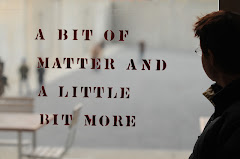
Sounding the Alarm, in Words and Light
Jenny Holzer: Protect Protect, including “Red Yellow Looming,” above, and other Holzer works from the past 15 years, is at the Whitney Museum of American Art through May 31. More Photos >
By ROBERTA SMITH
Published: March 12, 2009/The New York Times
Basically, Jenny Holzer has spent the last three decades pelting us with unsettling and increasingly relevant portents of things to come. In tones alternately poetic or oracular, inflamed or numb, Big-Brotherly or tender, Ms. Holzer’s terse snippets of prose have warned of evolving threats to life, liberty and the pursuit of happiness. She has tracked the inner thoughts of bereft lovers or shellshocked survivors and articulated the baser instincts unleashed by social chaos.
To do this, she has turned various user-friendly, pop-culture modes of public address into early warning systems, including posters, T-shirts, billboards, broadsheets, plaques, giant projections and incised marble benches. Electronic LED signs are her best-known, most spectacular method; they also reflect the military-commercial-entertainment complex that, bit by bit, her art exposes.
Ms. Holzer has infused Conceptual Art’s playful language with real-life seriousness and has put words in Minimalism’s sleek mouth. And few contemporary artists have as much right as she to say this: I told you so.
More.
Friday, March 13, 2009
Why Jonathan Jones is wrong about art
To accuse art of killing culture is to lump all art-making into a monumental mass. It's far more complicated than that
by Michael Archer
guardian.co.uk
Now, here's a trite comment: "All the shallowness of modern mass culture began in avant-garde art 40 years ago. We're Warhol's ugly brood". This was Jonathan Jones in his art blog earlier this week, lamenting the fact that modern art has "killed culture". This was the day after he told us that, anyway, "art as we know it is finished". Jones was bemoaning the absence of the sad, the severe and the serious, dimensions to experience that we were once regularly forced to encounter and deal with in art. I read his words at the end of a fortnight in which I had discussed with my students a range of contemporary artists whose work variously deals with economic exploitation in west Africa, the fraught politics of Israeli-Palestinian relations (from a number of perspectives), the quality of urban experience in India, the indelible trace of the holocaust in central Europe, power relations between central America and the US, and much more. All this work had been exhibited in Britain within the past year or so. All of it, too, was able to speak as it did of the human dimension to these issues through the command of the artists concerned over the possibilities inherent in the imagery and materials they used.
More.
Thursday, March 12, 2009
Assignment 3
Read:
1. “Ekphrasis and the Other” W.J.T. Mitchell (handout)
2. An Inadequate History of Conceptual Art Silvia Kolbowski
October, Vol. 92, (Spring, 2000), pp. 52-70
(available via JSTOR)
Reflect on the relation between image and text. i) Find an ekphrastic text which you feel is particularly effective. Prepare a short class presentation (5 mins) on why you feel your chosen example is so effective. Be specific and persuasive. ii) Select an image, event or artefact of your own choosing (this may include your own work if you wish) and write a short text (1 page) which attempts to engage imaginatively and critically with your chosen image/artefact. Bring both source material (image/artefact) and text (copied for other students) to the next class.
Monday, March 09, 2009
WATER WALK
John Cage performing "Water Walk" in January, 1960 on the popular TV show I've Got A Secret. via WFMU.
View.
John Cage performing "Water Walk" in January, 1960 on the popular TV show I've Got A Secret. via WFMU.
View.
Born Digital
A poet in the forefront of the field explores what is—and is not—electronic literature.
BY STEPHANIE STRICKLAND
Read at the Poetry Foundation.
A poet in the forefront of the field explores what is—and is not—electronic literature.
BY STEPHANIE STRICKLAND
Read at the Poetry Foundation.
Concealment and Law in the Work of Carey Young
Clancco || 4 March 2008
Carey Young’s art projects—invoking legal language and procedures—highlight the connection between law and visual culture without divorcing themselves from art historical discourses. Young’s work revolves around the role of categorization, narrative, and rhetorical/linguistic contestations. In particular, Young’s work seeks to elucidate how these three modes of linguistic production function not only within legal frameworks, but also how they in turn frame and are framed by other cultural discourses.
Read more.
HENRI CHOPIN LIVE IN FRANCE 2005
Pioneer of sound poetry Live at ESPACE GANTNER - Bourogne - France 2005 - at 84 years old.
Watch.
Pioneer of sound poetry Live at ESPACE GANTNER - Bourogne - France 2005 - at 84 years old.
Watch.
'Sounding-board of thought and feeling'
Sarah Maguire and Martin Argles present an illustrated performance of her poem, 'My Father's Piano'
View/listen.
Sarah Maguire and Martin Argles present an illustrated performance of her poem, 'My Father's Piano'
View/listen.
We meet in S1 all day tomorrow. Schedule is as follows:
9.30-11.00: Assignment 2 crit
11-00-12.00: Ron Jones x+1 (on how to respond to the ‘But is it art?’ question).
13.00-15.00: Tanja von Dahlgren: Word & Art & Film
15.00-16.00: Rolf Hughes: Ekphrasis
Wednesday
13.00: Kim West: Word + Film (as per schedule)
Thursday
13.00
Tom Sandqvist: Word + Dada (as per schedule)
Each meeting in S1.
Please document Assignments 1 and 2 in a way that is accessible online (as well as in other forms as appropriate).
Sunday, March 08, 2009
A MANCHA HUMANA / THE HUMAN STAIN
CONCEPTUAL ART IN THE CGAC COLLECTION
12 March - 31 May 2009
Curated by: Ellen Blumenstein
When describing the crucial years in the genesis of Minimal and Conceptual Art, the American art critic Lucy Lippard stated that there was a "cult of neutrality" in 1960's Minimalism, while Conceptual Art, around the same time, was focusing on the clarity of the idea. Taking this as a reference, the exhibition A mancha humana is based on the opposite extreme: the presumption that not only was this supposed purity and neutrality exceeded by the neo-conceptual artists of the eighties and nineties, but that a 'human stain' (a reference taken from the title of a book by the novelist Philip Roth) was always a constituent element of Conceptual Art from its very beginnings.
German curator Ellen Blumenstein has delved into the CGAC and Fundación ARCO collections focusing on the common rather than the dividing aspects of the relationship between Conceptual and non-Conceptual Art. The main aim of her curatorial project is to demonstrate that the notion of 'idea' is not necessarily opposed to 'subjectivity', 'poetry' or 'politics', but that a productive tension may arise from the relationships established between these diverse elements which run through a work of art.
A mancha humana begins with one of the most important –and recently acquired– works in the collection, the early Conceptual work by Joseph Kosuth, Clear, Square, Glass, Leaning (1965), in which he introduces a dialogue with other artistic positions of the same period in time: Donald Judd, Carl Andre, Sol LeWitt and Joseph Beuys, among others. It also considers a unique group of feminist artists such as Martha Rosler, Ana Mendieta, Helena Almeida or Anna Maria Maiolino; and politically-committed positions, as shown by the eastern European artists Július Koller or Mladen Stilinonovic. Finally, it contrasts these more historical positions with exponents of neo-Conceptualism such as Liam Gillick, Jac Leirner or Iñaki Bonillas.
CGAC (Galician Center for Contemporary Art)
Valle Inclán s/n
15704 Santiago de Compostela
A Coruña (Spain)
Telephone: 981 546619
Fax: 981 546625
http://www.cgac.org
Thursday, March 05, 2009
Assignment 2
Due: Tuesday 10 March 2009
A. Read
1. Dissociated Objects: The Statements/Sculptures of Lawrence Weiner
Birgit Pelzer and John Goodman
October, Vol. 90, (Autumn, 1999), pp. 76-108
2. An Inadequate History of Conceptual Art
Silvia Kolbowski
October, Vol. 92, (Spring, 2000), pp. 52-70
Both available via JSTOR
B. Write/design
“Using language + materials of your choice, in less than 100 words, design an ‘experience’ for your audience/viewer/reader.”
Sunday, March 01, 2009
Assignment 1
Devise a distribution system for your own practice designed to enhance the impact of its content on a target group of decision makers living in a specific region of your choice in Sweden. Define the content, visually, with language or otherwise and then describe how and why the system would work and estimate its effectiveness.
Presentation: 15 mins.
Due: Wednesday 4th March
Recommended reading for lectures on Thursday 5th March
My thanks to Ronald Jones for the following references:
Michael Fried, “Art and Objecthood”
Rosalind Krauss, Passages in Modern Sculpture
Rosalind Krauss, “Sculpture in the Expanded Field”
Alex Potts, “Space, Time and Situation”
*Philip Leider, “Literalism and Abstraction”
Donald Judd, “Specific Objects”
Tony Smith, Interview with Samuel Wagstaff
Maurice Merleau-Ponty, “Eye and Mind”
*Rosalind Krauss, “1965”
Wednesday, February 25, 2009
PAUL CHAN
MY LAWS ARE MY WHORES.
MARCH 01 – APRIL 12, 2009
Pimps Up
Rain or shine, it’s my habit, about five of an evening, to go for a stroll in the Palais-Royal. It’s me you see there, invariably alone, sitting on the d’Argenson bench, musing. I converse with myself about politics, love, taste, or philosophy. I give my mind license to wander wherever it fancies. I leave it completely free to pursue the first wise or foolish idea that it encounters, just as, on the Allée de Foy, you see our young rakes pursuing a flighty, smiling, sharp-eyed, snub-nosed little whore, abandoning this one to follow that one, trying them all but not settling on any. In my case, my thoughts are my whores.
--Denis Diderot, Rameau’s Nephew, 1761/1774
By the time Diderot finished Rameau’s Nephew, the Enlightment was conscious enough of itself as a movement to embrace its own caricature. If anyone had earned this right it was Diderot. His imprisonment in 1746 following publication of Letter on the Blind, in which he openly questioned the existence of God, helped unify the circle of French intellectuals known as the philosophes. Their use of empiricism to challenge a Christian worldview defined the so-called Age of Reason. As humanists, the philosophes’ writings touched on a range of subjects that would eventually evolve into discrete intellectual disciplines ranging from economics to natural history, and from the physical to the social sciences. Their critique of the morals, beliefs and laws regulating social relations was based on an inquiry into the origin of society. There was no shortage of paradigms to overturn as the philosophes were trying to understand the world in human rather than divine terms. Of the topics where social theory and a critique of morality would converge, none could form as volatile and complex a nucleus of discussion as sex.
Regarding sex, however, Enlightenment thought was distinguished neither by its critique of morality nor its consideration of sexual relations as being at the basis of society. As a staple of mores the world over, sex, by default, lends itself to any critique of morality. And the teleological relationship between sex and society has been part of a Western intellectual tradition since Plato’s Symposium. Instead, Enlightenment thought was marked by its use of sex to consider not the origins but the limits of society. Within a Christian framework, humankind was created in God’s image. Sex, however, in confirming humans as animals, spoke to our literally lower rather than higher selves. In an Enlightenment discourse challenging a Christian worldview, pleasures involving a regression to base instincts then became the site of transgression. As a result, sexual sovereignty was cast as the supreme expression of individual freedom. This last line of thought was indelibly inscribed into the trajectory of modernity by none other than the Marquis de Sade.
My laws are my whores. The immediate question raised by this provocative title, namely who pimps the law, belongs less to Diderot, from whom it was derived, and more to, say, Jean Genet. In answer to this question, Paul Chan has graced the entrance to his Renaissance Society exhibition with charcoal portraits of the nine United States Supreme Court Justices. As an artist whose work is informed by his political activism, Chan has never been one to shy away from pointed and scathing satire. The snarky hyperbole of Re: The Operation (2002), a 27-minute video in which Chan uses the genre of the soldier’s letter home to flesh out the psyches of former president George W. Bush’s inner circle, while highly entertaining, is also tragically on the mark in its depiction of an utterly vainglorious administration. In what was surely a surfeit of script-worthy material, Chan’s wit rose to the occasion. By comparison, the drawings of the Justices are a restrained affair. Their stilted quality is not a parody so much as an underscoring of their source in state portraiture. The only feature suggestive of caricature is the eerily recurring, smug, beatific grin that translates into a sense of detachment. Hung in the upper portion of the gallery, well over viewers’ heads, the Justices are literally above it all. But they are not the overseers in the sense of a panopticon. Instead, the Justices have been thrust to a more remote, ethereal, yet expansive realm of authority, making for a notable shift of tone in Chan’s work as his target has changed from the executive to the judicial branch of government.
Whereas the executive branch embodies the government in action, the High Court is the government in its guise as law, which does not avail itself to an accountability of the directness leveled at the presidency. This does not, however, preclude Chan from asking the simple question, who is the law, just as one might ask who is the president. As an answer, Chan, a champion of the literal, offers up these nine charcoal portraits of the Justices. But the larger question for Chan is, what is the law, specifically human law. If the remainder of the exhibition is taken as an answer, then, in a word, it is sex.
The portraits of the Justices find their corollary in fourteen large text-based drawings done after characters from works by Sade. A bowdlerized redux of the language describing the various characters’ sexual exploits and misfortunes, these drawings, although strictly text-based, nonetheless qualify as portraits albeit linguistically. These drawings are also studies for fonts which Chan has produced and made available on his website nationalphilistine.com. Each letter and symbol on the keyboard corresponds to a titillating phrase so that once installed, anything typed is rendered nonsensical pornographic drivel. The loss of control over what one types is metaphorically orgasmic. In addition to computer-based fonts, Chan has also had other texts translated into his fonts, as is the case with the episode of Law and Order featured on the plasma screen monitor. Chan translated the dialogue into one of his fonts and then reintroduced it as a running subtitle after removing the audio track.
In forsaking the figurative for the textual, Chan’s interest in sex proves to be something other than the pornographically explicit sense that comes to mind when one thinks of Sade. For Chan, the discourse of sex is where an inner law of human impulses and desire interfaces with an outer law responsible for regulating and/or containing libidinal forces. Marriage. Adultery. Sodomy. Pederasty. Rape. Incest. Sexual harassment. Prostitution. The state’s regulation of sexual relationships is arguably at the heart of the social compact as liberty’s limits are mapped within the most intersubjective of realms. The efficacy of the social compact in maximizing the pursuit of happiness is then mirrored in sexual relations as spelled out by the law, which over and above origin and limit, comprises the very structure of society. More significant than being a form of authority, a society’s laws are its architecture, which in Sade’s case was a cage whose bars he spent the better part of his life rattling. Chan’s juxtaposition of Sade and the Supreme Court Justices constructs an historical trajectory in which the United States is unavoidably to be viewed as the child of the Enlightenment. For better or for worse, Sade’s thought remains with us in perpetuity. Chan, however, is hardly interested in Sade the overly celebrated libertine. Of greater importance is the relationship between sex and the law, in which sex, as a basis of society, is also an issue for which the law achieves a degree of opacity, revealing its role in structuring society at its most fundamental level. For Chan, this is yet another layer of overtly political subject matter he has been steadily plying for the last decade.
Chan belongs to a generation of artists and collectives that are heir to debates about the relationship between aesthetics and politics; debates that emerged in the wake of a neo-autonomous minimalism on the one hand and widespread social unrest of the 1960s on the other. Told from the present vantage point, however, what were once two camps now find themselves partners in an expanded field of cultural production. The question of art’s relationship to affecting social change used to be fraught with a tension confirming the art world as a bubble with a discrete inside and outside. Thanks to the likes of Chan, activism, which once stood firmly outside the bubble, has become indispensable for the manner in which it informs a range of practices such that politics is no longer a quality of the work of art proper, but has instead become a way of looking. Likewise, the reverse is true. Activism may be viewed culturally, making its means and ends the subject of critique usually reserved for art. This two-way dialogue has helped dispense with false categories such as “political art,” and allowed artists to adopt a broader range of methods available to them on an as-needed basis. In this respect, Chan is a poster child for the post-medium era. His output includes activist pamphlets, production of large-scale performances (mounting Beckett’s Waiting for Godot in New Orleans’ lower 9th Ward), a website, drawings, collages, video installations and last but not least, several single-channel videos which in and of themselves display a range of approaches. Chan’s transition to a new body of work has taken place on the still-warm grave of the Bush presidency. Just as there was a need for socially engaged practices before George W. Bush’s presidency, the same applies afterward, even if at a minimum, to facilitate the transition from anger to hope.
More.
Sunday, February 22, 2009
Picasso, Images and Language
A dense and busy show on Picasso at Yale University investigates the importance of words — written, painted, printed, spoken — in Picasso’s art.
Check out NYT slideshow here.
A dense and busy show on Picasso at Yale University investigates the importance of words — written, painted, printed, spoken — in Picasso’s art.
Check out NYT slideshow here.
Tuesday, February 10, 2009
Many thanks to Brett for finding and sharing this:
The Pressures of the Text
Format: Quicktime .mov
Size: 537mb
Duration: 17 min.
Year: 1983
The Pressures of the Text integrates direct address, invented languages, ideographic subtitles, sign language, and simultaneous translation to investigate the feel and form of sense, the shifting boundaries between meaning and meaninglessness. A parody of art/critspeak, educational instruction, gothic narrative, and pornography, it has been performed as a live work at major media centers and new music festivals in the US and Europe. The piece was written, directed and delivered by Peter Rose; co-directed by Jessie Lewis; with sign language and ideographic symbols by Jessie Lewis; and with English simultran by Fred Curchack. The work was featured in the 1985 Whitney Biennial.
View.
Subscribe to:
Posts (Atom)